Sunday, January 20, 2008

Centerpieces or Favors

I'm crazy for the "bunny bowl" and have made it large and small. It looks good with paper doily quarters on the inside of the "bowl" pieces.
Designed by Carl Dahm 1956

Valentine Labels or Frames

I moved these labels to
http://meggiecat.blogspot.com/2015/03/meggiecats-labels.html


Japanese sewing patterns

This site has really grown since I last visited. Patterns for hat, baby shoes, bags, garments and accessories. It's in Japanese but the instructions include clear pictures.

Friday, January 18, 2008

Thursday, January 17, 2008

Cloth Hat Patterns

Back in the days before walk in closets there was a hat storage issue. Hats that could be stored flat became fashionable. The three patent designs shown here could be the starting point for some cute hats today. The fourth hat is just plain easy too though I would probably sew them all into the final shape. Click the pictures to be taken to the patents.


If anyone makes anything from these ideas please show me!

Here is another one.
 

Wednesday, January 16, 2008

Paper Purse Templates

Two patent paper purse templates from 1919. Click the pictures for links.

Bunny Dolls

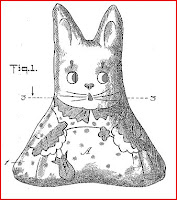
Isn't she cute? 1916 design by Jane Stokes.

I'm crazy for panel dolls that are front and back and think this next little 1913 bunny doll by Grace Dayton is as cute today as it was then. I prefer facial features like the picture on the right. If you want to change the face, trace the doll (I use Sharpie) then photocopy your adjusted pattern to the size you want.

I'm working on a post about making your own transfers but for this project I think a black photocopy ironed onto the fabric would do the trick. Photocopies are plastic and will not wash out. That isn't great for embroidery but is terrific for fabric painting. Using photocopies as transfers takes a little practice but is very useful on wood and metal too.

Tuesday, January 15, 2008

Embroidered Pillowcase Designs

Pillowcase designs from Coat's & Clark, Herrschner's and Bucilla. Click on the pictures to go to the patent drawings.


This one would have a crocheted skirt. I don't like that so I stitch a ruffle and cover the seam with tiny bias tape.


This scallop shows embroidery on the inside of the bottom edge (lower right illustration). I buy king size cases and cut the hem off. Mark the scallop on the inside of the case then sew one edge of bias tape to the marked line. Then trim the scallop aand fold the tape to the front and stitch down.

Pixie Hats

I'm always looking at shapes and thinking about potential products to make. Habits developed over a lifetime of crafting for money don't stop even when I'm no longer in the business. Maybe my eyes will spark ideas for you. More from Google Patents. Download the .pdfs

Look at this 1959 pixie hat designed by Tommie Lee Leatherwood.


And this 1943 hood designed by Morris Eskind

Monday, January 14, 2008

Handbag Pattern

This 1949 handbag by Cecilia M. Rose caught my eye.


I think getting a pattern from this requires some fiddling with the scanner to get each piece or hand trace each piece to photocopy. Remember that you really only need half of each piece to print out a pattern.

The pieces are the two sides and the two inside pockets. I would make it quilted and use bias tape to put it together and probably run some cord through all the bias tape and handles.

I had to come to the realization that I am not going to be able to use the resources and ideas I have so I'm sharing with you.

Fabric Baby Kimono Shoes

Cloth Baby Shoes by Esther A. Westberg

The truth is that I want some of these for myself. The patent has clear directions about construction. To get the pattern to the size you want measure just one sole on your print-out of the pattern pieces. Then we need to figure the proportion for enlarging the sole to the size we want.

I use this wonderful proportion calculator at Meisel.com. Enter the measurement (length and width) into the top boxes on the calculator and then you just need the length of the foot you want slippers for. Your result will be a percentage and all you will need to do is scan or photocopy your print out to that number. It may take scanning the pattern in pieces.

If you are wanting to make baby shoes sizes 00 through 8 the good folks at Trimfit offer a printable shoe chart for children that is quite cool and will be useful.

I have more shoe patterns to come as well as some hats, pinafores and aprons. Working with these ideas may take some fiddling but can be well worth it.

This is the frog closure I want for this shoe.