Showing posts with label Art Site. Show all posts
Showing posts with label Art Site. Show all posts
Monday, November 10, 2014

Monday, October 27, 2014


Monday, October 20, 2014


Thursday, August 28, 2008
Illustrated Letters
"Often the expression of joy or affection, illustrated letters represent an irrepressible urge to picture language. They are evidence of the writer's use of words and images to amplify the form and effect of a message. These are drawn entirely from the collections of the Archives of American Art, encompassing exuberant thank you notes, winsome love letters, lively reports of current events, graphic instructions and other personalized communiqués from the early nineteenth century through the 1980s, in each sender's distinctive style."
Visit Getting the Picture: Illustrated Letters in the Archives of American Art, Smithsonian. Browse by artist or date.
This is the first of several pages by Dale Chihuly

Visit Getting the Picture: Illustrated Letters in the Archives of American Art, Smithsonian. Browse by artist or date.
This is the first of several pages by Dale Chihuly
Monday, August 25, 2008
Picasso Lesson: Reduction to Abstract
Reducing an image to it's fewest essential lines has always been a challenge for me.
This Artyfactory article illustrates a progression in thinking.
Pablo Picasso created 'Bull' around the Christmas of 1945. 'Bull' is a suite of eleven lithographs that have become a master class in how to develop an artwork from the academic to the abstract. In this series of images, all pulled from a single stone, Picasso visually dissects the image of a bull to discover its essential presence through a progressive analysis of its form. Each plate is a successive stage in an investigation to find the absolute 'spirit' of the beast.
From this

To this

This Artyfactory article illustrates a progression in thinking.
Pablo Picasso created 'Bull' around the Christmas of 1945. 'Bull' is a suite of eleven lithographs that have become a master class in how to develop an artwork from the academic to the abstract. In this series of images, all pulled from a single stone, Picasso visually dissects the image of a bull to discover its essential presence through a progressive analysis of its form. Each plate is a successive stage in an investigation to find the absolute 'spirit' of the beast.
From this
To this
Monday, August 18, 2008
Graffiti
This post is for Kim whose son is interested in graffiti art. My concern is the ability to practice the art without getting arrested.
Neatorama has an interesting post about Paul Curtis who creates his art by cleaning the surfaces. There is also a link to an NPR interview.

Then there's this Flickr set by Jef Aerosol who has elevated graffiti on unstretched canvas into important pochoirs.

Neatorama has an interesting post about Paul Curtis who creates his art by cleaning the surfaces. There is also a link to an NPR interview.
Then there's this Flickr set by Jef Aerosol who has elevated graffiti on unstretched canvas into important pochoirs.
Saturday, July 12, 2008
EBSQ Self Representing Artists Zine
I have been following the coversation on Dabbled about making Shrinky Dinks from plastic in your recycle bin (found via CraftyPod). That thought led to this tutorial for Making Jewelry From Found Objects on the EBSQ Self Representing Artists site.

These charms are recycled plastic shrinky and those long beads are soda can metal inside plastic tubing.
Then I realize that the entire site is chock full of interesting information and that I was reading just one article in their monthly Zine. Love it.
These charms are recycled plastic shrinky and those long beads are soda can metal inside plastic tubing.
Then I realize that the entire site is chock full of interesting information and that I was reading just one article in their monthly Zine. Love it.
Tuesday, October 04, 2005
Owen Jones 1809-1874
From the University of Wisonsin Digital Library for the Decorative Arts and Material Culture.
Full facsimiles of The Grammar of Ornament (1856) and Examples of Chinese ornament selected from objects in the South Kensington Museum and other collections (1867).
Jones, an architect and ornamental designer who served as superintendent of works at the Great Exhibition of 1851, was instrumental in the application of chromolithography to book illustration. In his travels as a young man he became fascinated by Eastern forms, and the books he published reproducing these patterns influenced the design of English wallpaper, carpets, and furniture.
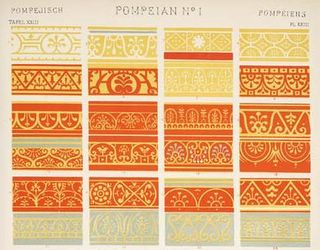
The Grammar of Ornament, one of the masterpieces of nineteenth-century color printing, is a systematic presentation of ornamental motifs from the ancient world through the Renaissance. There are several thousand examples; each plate depicts a group with common chronological and geographical origins. The individual plates, lithographed by Francis Bedford, are tied together by a unified color scheme. As the title suggests, Jones intended the work to be used as a practical guide and resource for designers, and the introduction includes a set of principles covering "the arrangement of form and color."
The Grammar of Ornament. 1856
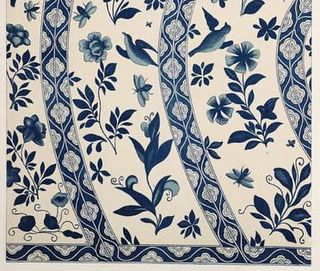
Examples of Chinese ornament selected from objects in the South Kensington Museum and other collections. 1867
The color plates are offered in 4 resolutions. If you want to print them choose the largest page size to save. Look for this tool.

Full facsimiles of The Grammar of Ornament (1856) and Examples of Chinese ornament selected from objects in the South Kensington Museum and other collections (1867).
Jones, an architect and ornamental designer who served as superintendent of works at the Great Exhibition of 1851, was instrumental in the application of chromolithography to book illustration. In his travels as a young man he became fascinated by Eastern forms, and the books he published reproducing these patterns influenced the design of English wallpaper, carpets, and furniture.
The Grammar of Ornament, one of the masterpieces of nineteenth-century color printing, is a systematic presentation of ornamental motifs from the ancient world through the Renaissance. There are several thousand examples; each plate depicts a group with common chronological and geographical origins. The individual plates, lithographed by Francis Bedford, are tied together by a unified color scheme. As the title suggests, Jones intended the work to be used as a practical guide and resource for designers, and the introduction includes a set of principles covering "the arrangement of form and color."
The Grammar of Ornament. 1856
Examples of Chinese ornament selected from objects in the South Kensington Museum and other collections. 1867
The color plates are offered in 4 resolutions. If you want to print them choose the largest page size to save. Look for this tool.

Subscribe to:
Posts (Atom)